IC 5070
Pelican Nebula
A Stellar Nursery
The Pelican Nebula (IC 5070) is a striking emission nebula in the constellation Cygnus, about 1,800 light-years from Earth. Its glowing gas and dark dust lanes form a shape resembling a pelican. Beneath this familiar silhouette lies an active stellar nursery where young stars, stellar winds, gas, and dust continually reshape the surrounding clouds. The nebula contains ionized hydrogen, cold molecular gas, dust, and young stars. Energy from newly formed stars heats and ionizes the surrounding gas, producing its characteristic red and pinkish-red glow and driving an ionization front through the clouds. Dense filaments of gas and dust remain shielded within the nebula, with some may contine to collapse under their own gravity to eventually form new stars.
Near the center-left of the image is Herbig–Haro 555 (HH 555), a luminous jet thought to be powered by a hidden young protostar. It lies near the tip of a prominent “elephant trunk” dust pillar within the nebula. The young, low-mass star is surrounded by a disk of material, from which narrow, oppositely directed jets are launched. As these jets interact with the surrounding gas, they produce the delicate, glowing tendrils extending from the tip of the pillar.
Near the bottom center of the image is 57 Cygni, a blue-white binary star system about 530 light-years from Earth that lies in the foreground of the Pelican Nebula rather than being part of its star-forming region.
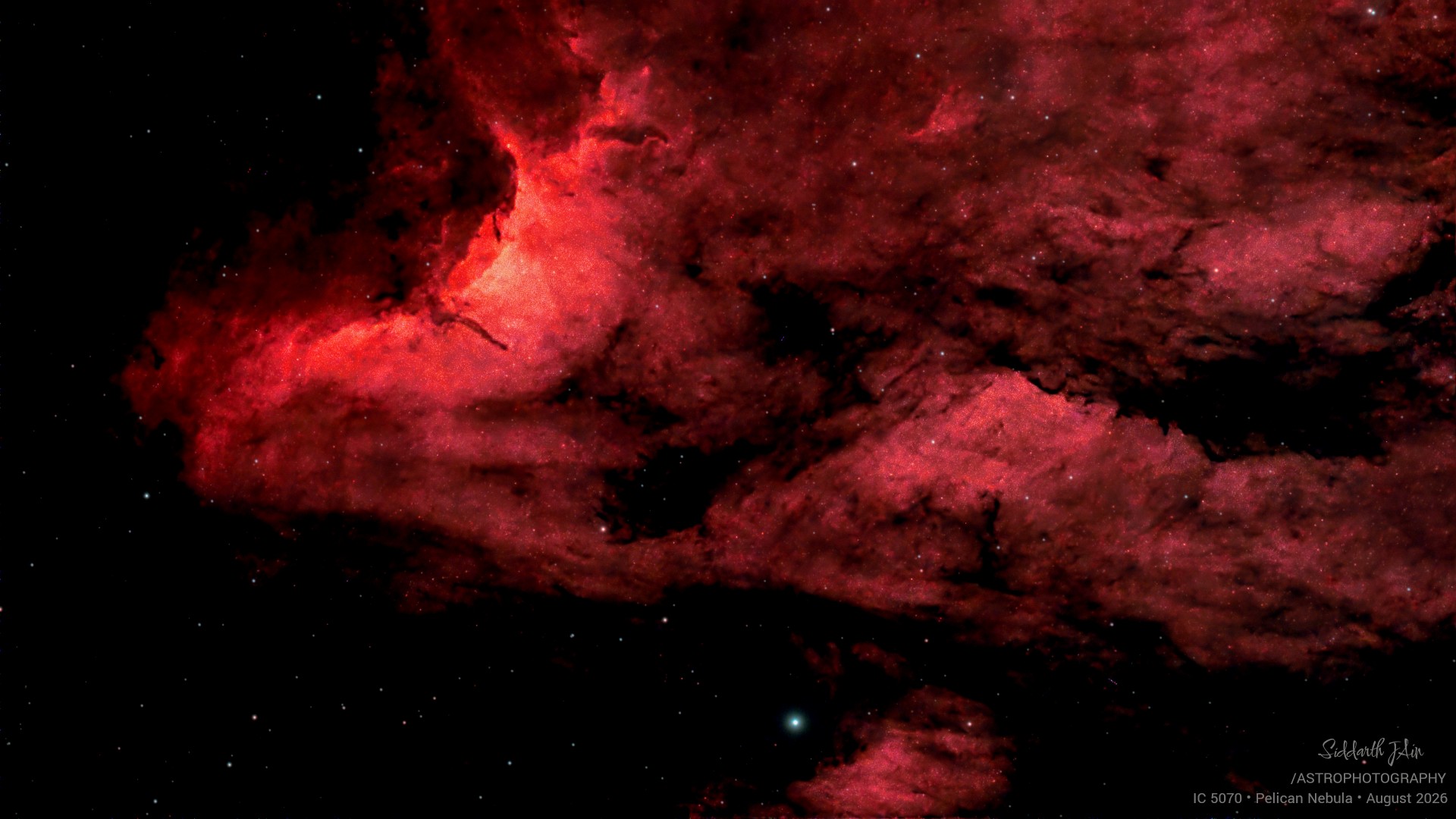
The Pelican Nebula (IC 5070), an active stellar nursery in Cygnus; S. Jain, Astrophotograph, Bortle 8 skies, August 2026.